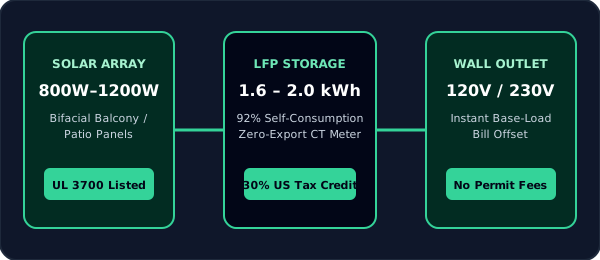
UL 3700 & UK G98 Plug-in Solar
Connect 800W–1,200W balcony panels with smart LFP storage to reach 92% self-consumption without utility interconnection fees.
Instant engineering calculators built on NREL solar data, 2026 utility Time-of-Use (TOU) tariffs, and NEC Article 220.83 load formulas. Zero phone numbers or email gates required.
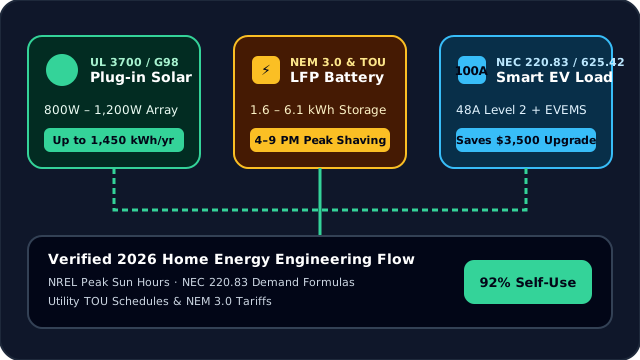
Connect 800W–1,200W balcony panels with smart LFP storage to reach 92% self-consumption without utility interconnection fees.
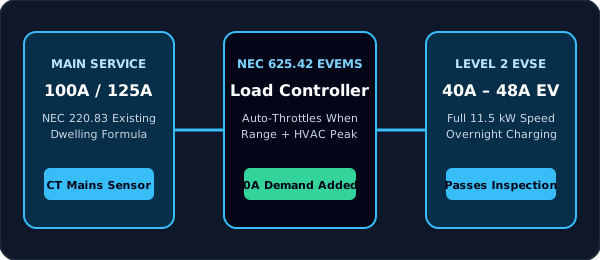
Verify existing dwelling demand load and use a listed NEC 625.42 EVEMS controller to avoid a $3,500 200A service upgrade.
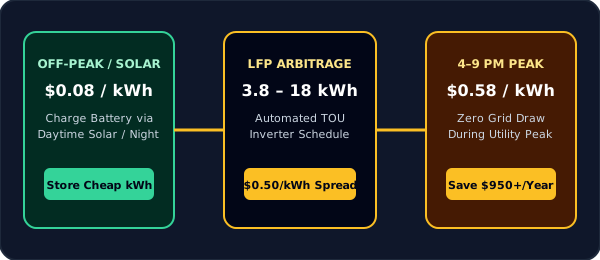
Store 8¢/kWh solar exports or off-peak grid power and discharge during 4–9 PM peak windows up to 68¢/kWh.
California Legal Verdict: Passed Legislature (SB 868 — Awaiting Governor Signature, Sept 2026). SB 868 passed the California Legislature in August 2026 to legalize up to 1,200W plug-in solar systems on standard 120V outlets without utility interconnection fees (effective Jan 1, 2027 upon enactment). Under NEM 3.0, combining plug-in solar with a 1.6kWh–2kWh LFP battery avoids exporting at 8¢/kWh and offsets 58¢/kWh evening peak power.
Engineering Rule: Under NEC 220.83, the first 8 kVA of general load counts at 100%, remainder at 40%, plus 100% HVAC and 125% EV continuous load. Adding a listed NEC 625.42 EVEMS ($599) throttles charging during peak stove/AC use so your 100A panel passes inspection without a $3,500 200A service upgrade.
Under PG&E NEM 3.0 (Net Billing), daytime solar exports earn only ~8¢/kWh while 4–9 PM peak electricity costs 56¢–62¢/kWh. Storing solar or off-peak energy in a 3.8kWh–6kWh LFP battery saves $950–$1,650/year.